

How To Make A Story Go Viral
Make Your Next Medium Story Go Viral: A Marketing Professor Shares His Research
6 principles and 14 actionable steps you can implement in your writing right now

We all strive to get more eyes on our writing. We all want likes, claps, and, most importantly, we want others to share our content.
With every piece we produce, we hope that this will be it. The big hit. The piece that goes viral. The article that gets you noticed.
The truth is, this rarely happens. But it's not impossible.
I like to look at this issue from two perspectives:
- You need to put out content consistently.
- You need to follow principles that make it more likely your content will get shared.
For learning how to put out c o ntent consistently, follow the big names, such as Nicolas Cole, Ayodeji Awosika, and Shaunta Grimes. But if you want to learn something about the second perspective, read on.
In his book "Contagious — Why Things Catch On" (no relation to COVID-19), Jonah Berger lays out six principles — or, as he puts it, STEPPS — to make an idea or a product contagious.
The principles are:
- Social currency
- Triggers
- Emotion
- Public
- Practical Value
- Stories
In what follows, you'll learn how these principles apply to writing on Medium.
Social Currency — And the Hidden Drive to Look Cool
Now let me tell you a secret. Shhh, you ready? Here is the secret — we all want to look good in front of others. Social currency is all about how a certain idea or a product will make you look in social settings. In other words, the question you should be asking is: Will this make the reader look cool when he shares it?
How can you do that?
Inner remarkability
Snapple originally started with jokes under the bottle cap — a strategy that soon proved unsuccessful. Turns out, you don't have enough space to make a good joke on such a small space. Duh. But what you do have is space to jot down some fun facts. Which facts, you ask?
- Animals that lay eggs don't have belly buttons.
- Beavers can hold their breath for 45 minutes underwater.
- A bee has five eyelids.
As you can see, these are the perfect fodder for a conversation. Whipping one of these out is bound to make you look fun and make the other person interested.
How to apply to Medium?
People share things that are remarkable — things worth making a remark about. So, in order for your story to get shared, try to emphasize what's remarkable about it.
- Are you taking a novel approach to an established issue? Try a different angle than others.
- Is your writing funny, making the dry material shine in the sea of mediocrity? Add little tidbits of fun here and there. Don't be shy.
Triggers — The Invisible Force Behind Our Actions
People are forgetful. Like, a lot. Even when you wow the reader with your immaculate prose, shatter their world with rock-solid argumentation, and top it all off with the right amount of humor, people will soon forget. The simple reason being — there is a lot of stuff out there. Bummer, I know.
Enter triggers. Triggers are the reason people end up talking about our ideas or products even after the exposure has ended. They are the deceptively simple things in your environment. The fridge that makes you think about food; the mellow time after you've arrived from work that makes you want to watch Netflix and relax; or the music that makes you think about gaming.
How to apply to Medium?
Getting triggers to work for you on Medium will be tough. Triggers are usually solid things in your environment, certain time periods, or emotions. Regardless, there are steps you can take.
- Keep a consistent style throughout your pieces. Over time, this specific style will get associated with your ideas. For practical steps on how to create a content style guide, read this.
- Will the message you're communicating be triggered by the everyday environment? Depending on what you're writing about, you can forge associations with the reader's usual environment.
Now it's time for the feels.
Emotions — The Impetus of Human Behavior
When penning the next article, think about what emotion you want your readers to feel. Make them feel — and I mean really feel — and they will share.
What emotions make people share?
Think back to the situation where:
- You heard a magical piece of music.
- You saw a movie where the actor played the scene out of his mind (think Leo DiCaprio in any of his movies).
- You saw the landscape outstretched in front of you, bathed in the sunset light.
All of those instances evoke feelings of awe. When you're able to instill such feelings in your readers, they will share your content.
But awe is not the only emotion that makes people share. High-arousal emotions such as anger and anxiety do, too. For anger, think Trump's tweeting — it makes you angry and you want others to know how mad you are in the hopes they share the emotion.
The same goes for anxiety. Take the current situation, for example. I can't count the number of times my friends (and myself) felt the need to talk about the coronavirus recently. And I think it's in part because we're anxious and seek comfort. In other words, sharing the pain alleviates it.
On the opposite side of the spectrum, we have low-arousal emotions that aren't share-worthy, like sadness. This also intuitively makes sense — you don't want to be Debbie the Downer and make people sad.
How to apply to Medium?
- Invoke the wow moments — share something unexpected that stops people in their tracks (usually headline material).
- Rather than statistics, focus on emotions when you want your content shared. This usually means using some kind of narrative (stories, anecdotes, your own experience).
- Arousal makes people act. Make your piece exciting by adding controversy, or showing people they can make a difference.
Public — Is the Behavior Observable?
How can you tell someone is wearing Apple's headphones? It's easy, right? They're white. Nowadays, not a thing you'd think twice over, but earlier, all the headphones were black. This simple change of color made Apple instantly recognizable as a brand.
How does this work?
We are social creatures. We want to fit in. So, we conform to peer pressure and give in to social influence — we imitate what we see. That's how viral stuff goes viral — once it hits a certain point, it snowballs and becomes a (small) part of the collective consciousness.
How to apply to Medium?
- Let your visuals stand out. When writing on Medium, we all use the same framework and have the same formatting options. As a result, we can't make a piece visually stand out so easily. But take Zat Rana, for example. Every piece of his is easily distinguishable because he uses the same style of pictures and headlines. And, like Apple's Earbuds, he stands out.
- Point out the discrepancy between the private and the public opinion. This one is a bit tricky. But let's take a look at Mark Manson and his most successful article—The Subtle Art of Not Giving a Fuck. The basic premise is simple and we all understand it on some level — don't sweat the small stuff, save your fucks for the important stuff. Yet we consistently see people freaking out over small stuff that doesn't deserve it. As Manson puts it,
We give a fuck when a show we liked was cancelled on TV. We give a fuck when our coworkers don't bother asking us about our awesome weekend. We give a fuck when it's raining and we were supposed to go jogging in the morning.
So, we see people freaking out (observable, public) yet we feel differently (unobservable, private). And what Manson does so fucking (couldn't resist) well is to point out this difference. When you read his article, you have a sense that you're being heard and understood. And the next thought is, "Man, more people need to read this." And then you'll hit share. That's the magic of making the private opinions public. So speak your mind when you write — maybe others think the same way.
Now let us get practical, shall we?
Practical Value — Be Selfishly Helpful
An immense help on our never-ending quest to look cool in front of others is sharing stuff of practical value. It can be anything that helps to improve other people's lives by solving their problems.
I would say that this principle is the most easily graspable for us Medium writers. Help others by writing useful stuff and you'll get rewarded by people sharing your content.
How to apply to Medium?
- Use listicles. Why? Because people have so many other options, and by organizing your valuable content into an easily digestible format of the listicle, you're making it more likely for your content to get shared.
- Make it clear where the value is— bold the shit out of your main points. The community seems to be split on this one. One camp says you shouldn't do it and let the reader figure out where he or she sees the value. The other camp says you should bold your main points as you see them. In other words, to guide the reader.
I think this depends on what form the piece of writing has. If it's a listicle, then I am leaning towards the second camp. Why? Because I know how I read Medium articles: I scan the whole story at first, looking for stuff that interests me. If I do find something, I give the article a shot. But even then, my eye consciously looks for anchors in text, the bold stuff, that makes it easier for me to organize it. This is different when I'm reading a book or a philosophical article. There, I'd find bold text out of place (though it still might be helpful).
So, bold based on your content.
Also, promise and emphasize the benefits for the reader. When you write a story, have your reader in mind. More precisely, the benefit he or she derives from your piece. If you manage to emphasize that, you're smoothing the way for your piece to get shared.
For this to work, start as soon as in the headline ("And How You Can Do It, Too") or introduction, where you explain why what you're writing about is a problem for that particular person. And then, conveniently, promise the benefits in the next paragraph for solving it.
This is the third paragraph of Jason Shen's story "How Great Writing Begins":
Without a good beginning, we will lose our readers to another tab in the browser, a message from a friend, or an impulse to check their email. We must learn to write beginnings that grab our readers and never let go, drawing them into our article and compelling them to read through to the end.
As you can see, he clearly states what you stand to lose if you don't begin your article well. And then he goes on to pose a tantalizing question, "So how do the masters of feature writing begin their articles?"
A promise of a benefit — if you read on, that is. The next part is to deliver on that promise in your body.
But there is another way to begin your writing.
Stories and the Power of Narrative
A good last — stories. As we've already talked about above, people don't share logic, they share emotions. And stories are the perfect vessels for emotions. Why? Because stories transport you to the character's shoes, making whatever you're writing about more relatable. Logic doesn't do that.
How to apply to Medium?
- Start with a story. There are many ways to start your next Medium piece — an interesting fact, a statistic, an unexpected statement. But the most successful one? A story.
- Make the key idea a part of the story. By weaving your takeaway into a story form, you're increasing the chances of people remembering it and sharing it. Why? Because our memories work a bit like stories. A quick test — which sequence of words are you more likely to remember?
- Easily over horse the fence the hopped.
- The horse hopped over the fence easily.
The second one is easier, right? Why? Because it's a tiny story. It has a character doing an action. It's also a small example of how our memories work — we don't remember facts per se, we remember patterns. And these patterns can get activated during conversations with other people.
In short, start with a story and make sure your key takeaway is a part of it.
Putting It All Together
By using these six STEPPS, you can make your story on Medium contagious.
Here is a handy table with the main points:
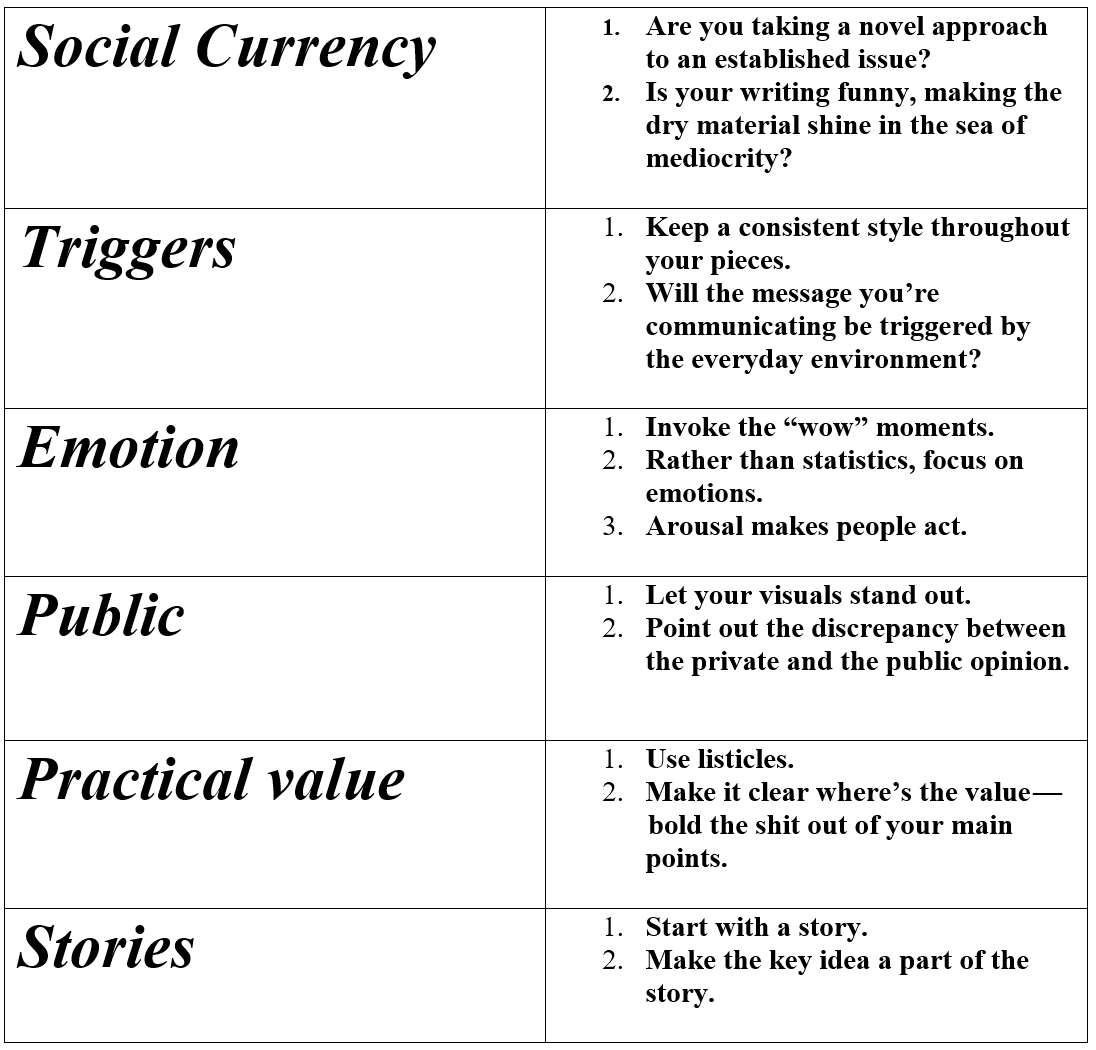
With that, you are well equipped to give the viral story here on Medium a shot.
How To Make A Story Go Viral
Source: https://bettermarketing.pub/make-your-next-story-viral-marketing-professor-shares-his-research-adapted-for-medium-ac80e35b42d
Posted by: reyesfonse1937.blogspot.com
0 Response to "How To Make A Story Go Viral"
Post a Comment