

2 Pi Divided By 1/2
| Radian | |
|---|---|
 An arc of a circle with the aforementioned length as the radius of that circumvolve subtends an angle of 1 radian. The circumference subtends an angle of 2π radians. | |
| General data | |
| Unit of measurement organization | SI |
| Unit of | Angle |
| Symbol | rad,c or r |
| Conversions | |
| 1 rad in ... | ... is equal to ... |
| milliradians | 1000 mrad |
| turns | 1 / 2π plow |
| degrees | 180° / π ≈ 57.296° |
| gradians | 200g / π ≈ 63.662g |
The radian, denoted by the symbol rad, is the unit of bending in the International System of Units (SI), and is the standard unit of athwart measure out used in many areas of mathematics. The unit was formerly an SI supplementary unit (before that category was abolished in 1995).[i] The radian is divers in the SI as existence a dimensionless unit with i rad = 1.[2] Its symbol is accordingly ofttimes omitted, particularly in mathematical writing.
Definition
One radian is defined as the bending subtended from the center of a circle which intercepts an arc equal in length to the radius of the circle.[3] More more often than not, the magnitude in radians of a subtended angle is equal to the ratio of the arc length to the radius of the circle; that is, θ = s/r , where θ is the subtended angle in radians, due south is arc length, and r is radius. A right bending is exactly π / ii radians.[4]
The magnitude in radians of ane consummate revolution (360 degrees) is the length of the entire circumference divided past the radius, or 2π r / r , or 2π. Thus 2π radians is equal to 360 degrees, meaning that ane radian is equal to 180/π degrees ≈ 57.2957795130 82320 876... degrees.[v]
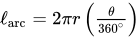
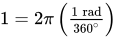
The relation 2π rad = 360° can be derived using the formula for arc length, . Since radian is the measure out of an angle that subtends an arc of a length equal to the radius of the circumvolve, . This can exist farther simplified to . Multiplying both sides by 360° gives 360° = iiπ rad.

Unit symbol
The International Agency of Weights and Measures[4] and International Organization for Standardization[6] specify rad as the symbol for the radian. Culling symbols that were in use in 1909 are c (the superscript letter c, for "round measure out"), the alphabetic character r, or a superscript R,[7] only these variants are infrequently used, as they may be mistaken for a degree symbol (°) or a radius (r). Hence a value of ane.ii radians would be written today as i.2 rad; primitive notations could include i.2 r, i.2rad, 1.2c, or 1.2R.
In mathematical writing, the symbol "rad" is frequently omitted. When quantifying an angle in the absence of any symbol, radians are assumed, and when degrees are meant, the degree sign ° is used.
Dimensional analysis
Plane bending is defined as θ = s/r , where θ is the subtended bending in radians, s is arc length, and r is radius. Ane radian corresponds to the angle for which southward = r , hence 1 radian = ane m/m.[8] However, is only to be used to express angles, non to limited ratios of lengths in general.[four] A like calculation using the surface area of a circular sector θ = 2A/r 2 gives one radian every bit ane g2/m2.[ix] The fundamental fact is that the radian is a dimensionless unit of measurement equal to 1. In SI 2019, the radian is defined accordingly equally i rad = i.[10] It is a long-established practice in mathematics and across all areas of science to make employ of .[11] [12] In 1993 the AAPT Metric Committee specified that the radian should explicitly announced in quantities just when different numerical values would be obtained when other bending measures were used, such as in the quantities of angle measure (rad), angular speed (rad/s), athwart dispatch (rad/due south2), and torsional stiffness (Northward⋅m/rad), and not in the quantities of torque (N⋅m) and athwart momentum (kg⋅thousand2/south).[13]


Giacomo Prando says "the current situation leads inevitably to ghostly appearances and disappearances of the radian in the dimensional analysis of physical equations."[14] For example, a mass hanging past a string from a pulley volition ascent or drop past y = rθ centimeters, where r is the radius of the pulley in centimeters and θ is the bending the pulley turns in radians. When multiplying r past θ the unit of radians of disappears from the result. Similarly in the formula for the angular velocity of a rolling wheel, ω = v/r , radians announced in the units of ω but non on the right mitt side.[15] Anthony French calls this phenomenon "a perennial problem in the teaching of mechanics".[xvi] Oberhofer says that the typical advice of ignoring radians during dimensional analysis and adding or removing radians in units co-ordinate to convention and contextual knowledge is "pedagogically unsatisfying".[17]
At to the lowest degree a dozen scientists betwixt 1936 and 2022 have made proposals to treat the radian as a base unit of measurement of mensurate defining its own dimension of "angle".[18] [nineteen] [20] Quincey's review of proposals outlines two classes of proposal. The get-go option changes the unit of a radius to meters per radian, but this is incompatible with dimensional analysis for the area of a circumvolve, πr 2 . The other pick is to innovate a dimensional abiding. According to Quincey this arroyo is "logically rigorous" compared to SI, but requires "the modification of many familiar mathematical and concrete equations".[21]
In particular Quincey identifies Torrens' proposal, to introduces a constant η equal to ane inverse radian (1 rad−1) in a style like to the introduction of the constant ε 0.[21] [a] With this change the formula for the angle subtended at the middle of a circle, s = rθ , is modified to become s = ηrθ , and the Taylor series for the sine of an bending θ becomes:[20] [22]

The capitalized function is the "complete" role that takes an argument with a dimension of angle and is independent of the units expressed,[22] while is the traditional role on pure numbers which assumes its argument is in radians.[23] tin can exist denoted if it is clear that the complete grade is meant.[20] [24]


SI can exist considered relative to this framework as a natural unit system where the equation η = 1 is assumed to hold, or similarly, 1 rad = i. This radian convention allows the omission of η in mathematical formulas.[25]
A dimensional constant for angle is "rather strange" and the difficulty of modifying equations to add together the dimensional constant is probable to preclude widespread employ.[20] Defining radian as a base unit may be useful for software, where the disadvantage of longer equations is minimal.[26] For example, the Boost units library defines angle units with a plane_angle dimension,[27] and Mathematica's unit organisation similarly considers angles to have an bending dimension.[28] [29]
Conversions
| Turns | Radians | Degrees | Gradians |
|---|---|---|---|
| 0 plow | 0 rad | 0° | 0g |
| 1 / 24 turn | π / 12 rad | fifteen° | 16+ 2 / 3 g |
| one / xvi turn | π / viii rad | 22.five° | 25g |
| one / 12 plow | π / half dozen rad | 30° | 33+ ane / iii grand |
| 1 / 10 plough | π / five rad | 36° | xlg |
| one / 8 plough | π / iv rad | 45° | 50k |
| 1 / 2π plough | 1 rad | c. 57.3° | c. 63.viig |
| i / half-dozen plow | π / 3 rad | lx° | 66+ ii / 3 chiliad |
| 1 / 5 plow | 2π / 5 rad | 72° | 80k |
| ane / four turn | π / 2 rad | 90° | 100chiliad |
| ane / 3 turn | iiπ / 3 rad | 120° | 133+ i / 3 g |
| 2 / v turn | 4π / v rad | 144° | 160grand |
| 1 / 2 plow | π rad | 180° | 200m |
| 3 / iv plow | 3π / ii rad | 270° | 300one thousand |
| 1 turn | iiπ rad | 360° | 400g |
Between degrees
Equally stated, one radian is equal to . Thus, to convert from radians to degrees, multiply past .


For case:


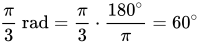
Conversely, to convert from degrees to radians, multiply past .


For example:


Radians can exist converted to turns (consummate revolutions) by dividing the number of radians past 2π.
Between gradians
radians equals one turn, which is by definition 400 gradians (400 gons or 400k). So, to convert from radians to gradians multiply by , and to convert from gradians to radians multiply by . For case,




Usage
Mathematics
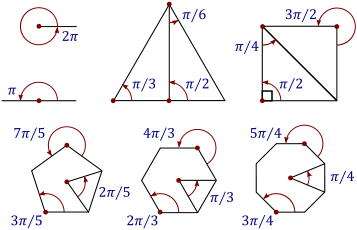
Some mutual angles, measured in radians. All the large polygons in this diagram are regular polygons.
In calculus and about other branches of mathematics beyond practical geometry, angles are universally measured in radians. This is because radians have a mathematical "naturalness" that leads to a more than elegant conception of a number of important results.
Near notably, results in assay involving trigonometric functions can exist elegantly stated, when the functions' arguments are expressed in radians. For example, the use of radians leads to the simple limit formula
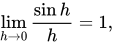
which is the basis of many other identities in mathematics, including
- [5]
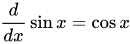
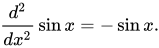
Because of these and other properties, the trigonometric functions appear in solutions to mathematical problems that are non obviously related to the functions' geometrical meanings (for example, the solutions to the differential equation , the evaluation of the integral and so on). In all such cases, information technology is found that the arguments to the functions are nigh naturally written in the course that corresponds, in geometrical contexts, to the radian measurement of angles.


The trigonometric functions also have simple and elegant series expansions when radians are used. For example, when x is in radians, the Taylor series for sinx becomes:

If x were expressed in degrees, then the series would contain messy factors involving powers of π/180: if x is the number of degrees, the number of radians is y = π x / 180, so

In a similar spirit, mathematically important relationships between the sine and cosine functions and the exponential function (run into, for case, Euler's formula) can be elegantly stated, when the functions' arguments are in radians (and messy otherwise).
Physics
The radian is widely used in physics when angular measurements are required. For example, athwart velocity is typically measured in radians per second (rad/s). One revolution per 2d is equivalent to 2π radians per 2nd.
Similarly, angular acceleration is often measured in radians per second per second (rad/sii).
For the purpose of dimensional analysis, the units of athwart velocity and athwart acceleration are s−1 and s−2 respectively.
Besides, the stage difference of two waves can also exist measured in radians. For case, if the phase divergence of two waves is (n⋅twoπ) radians, where n is an integer, they are considered in stage, whilst if the phase divergence of 2 waves is ( due north⋅2π + π ), where n is an integer, they are considered in antiphase.
Prefixes and variants
Metric prefixes for submultiples are used with radians. A milliradian (mrad) is a thousandth of a radian (0.001 rad), i.due east. ane rad = xiii mrad. There are 2π × m milliradians (≈ 6283.185 mrad) in a circumvolve. So a milliradian is just under 1 / 6283 of the bending subtended by a full circumvolve. This unit of angular measurement of a circumvolve is in common use by telescopic sight manufacturers using (stadiametric) rangefinding in reticles. The deviation of laser beams is as well usually measured in milliradians.
The angular mil is an approximation of the milliradian used past NATO and other armed services organizations in gunnery and targeting. Each athwart mil represents ane / 6400 of a circle and is 15 / viii % or ane.875% smaller than the milliradian. For the pocket-sized angles typically institute in targeting work, the convenience of using the number 6400 in adding outweighs the modest mathematical errors it introduces. In the by, other gunnery systems have used dissimilar approximations to 1 / 2000π ; for instance Sweden used the i / 6300 streck and the USSR used 1 / 6000 . Being based on the milliradian, the NATO mil subtends roughly one m at a range of g m (at such small-scale angles, the curvature is negligible).
Prefixes smaller than milli- are useful in measuring extremely small-scale angles. Microradians (μrad, ten−half-dozen rad) and nanoradians (nrad, x−9 rad) are used in astronomy, and can also be used to measure out the beam quality of lasers with ultra-depression divergence. More common is the arc 2nd, which is π / 648,000 rad (around 4.8481 microradians).
History
Pre-20th century
The idea of measuring angles past the length of the arc was in utilise by mathematicians quite early. For instance, al-Kashi (c. 1400) used then-chosen diameter parts equally units, where one diameter part was one / 60 radian. They also used sexagesimal subunits of the diameter part.[30] Newton in 1672 spoke of "the angular quantity of a body's circular motility", just used it merely as a relative measure out to develop an astronomical algorithm.[31]
The concept of the radian measure is normally credited to Roger Cotes, who died in 1716. By 1722, his cousin Robert Smith had collected and published Cotes' mathematical writings in a book, Harmonia mensurarum.[32] In a chapter of editorial comments, Smith gave what is probably the start published calculation of ane radian in degrees, citing a note of Cotes that has non survived. Smith described the radian in everything but name, and recognized its naturalness equally a unit of angular measure.[33] [34]
In 1765, Leonhard Euler implicitly adopted the radian equally the angle unit for all equations involving rotation.[31] Specifically, Euler defined angular velocity as "The angular speed in rotational motion is the speed of that betoken, the distance of which from the axis of gyration is expressed past one."[35] Euler was probably the commencement to adopt this convention, referred to as the radian convention, which gives the simple formula for athwart velocity ω= v/r . Equally discussed in § Dimensional analysis, the radian convention has been widely adopted, and other conventions take the drawback of requiring a dimensional constant, for case ω = five/(ηr) .[25]
Prior to the term radian becoming widespread, the unit was commonly chosen circular measure of an angle.[36] The term radian first appeared in print on 5 June 1873, in examination questions fix by James Thomson (brother of Lord Kelvin) at Queen's College, Belfast. He had used the term as early as 1871, while in 1869, Thomas Muir, then of the University of St Andrews, vacillated betwixt the terms rad, radial, and radian. In 1874, after a consultation with James Thomson, Muir adopted radian.[37] [38] [39] The name radian was not universally adopted for some time after this. Longmans' Schoolhouse Trigonometry even so called the radian round measure when published in 1890.[twoscore]
As a SI unit of measurement
As Paul Quincey et al. writes, "the status of angles within the International Arrangement of Units (SI) has long been a source of controversy and defoliation."[41] In 1960, the CGPM established the SI and the radian was classified as a "supplementary unit" forth with the steradian. This special class was officially regarded "either as base units or as derived units", equally the CGPM could not reach a decision on whether the radian was a base unit or a derived unit.[42] Richard Nelson writes "This ambivalence [in the classification of the supplemental units] prompted a spirited discussion over their proper estimation."[43] In May 1980 the Consultative Committee for Units (CCU) considered a proposal for making radians an SI base unit, using a constant α 0 = 1 rad,[44] [25] but turned information technology downward to avert an upheaval to current practice.[25]
In October 1980 the CGPM decided that supplementary units were dimensionless derived units for which the CGPM allowed the liberty of using them or non using them in expressions for SI derived units,[43] on the basis that "[no ceremonial] exists which is at the same time coherent and convenient and in which the quantities plane angle and solid angle might be considered equally base quantities" and that "[the possibility of treating the radian and steradian as SI base units] compromises the internal coherence of the SI based on only seven base units".[45] In 1995 the CGPM eliminated the grade of supplementary units and defined the radian and the steradian as "dimensionless derived units, the names and symbols of which may, but need not, be used in expressions for other SI derived units, equally is user-friendly".[46] Mikhail Kalinin writing in 2019 has criticized the 1980 CGPM decision as "unfounded" and says that the 1995 CGPM conclusion used inconsistent arguments and introduced "numerous discrepancies, inconsistencies, and contradictions in the wordings of the SI".[47]
At the 2013 meeting of the CCU, Peter Mohr gave a presentation on alleged inconsistencies arising from defining the radian equally a dimensionless unit rather than a base unit of measurement. CCU President Ian 1000. Mills declared this to be a "formidable problem" and the CCU Working Group on Angles and Dimensionless Quantities in the SI was established.[48] The CCU met most recently in 2021,[update] just did not accomplish a consensus. A minor number of members argued strongly that the radian should be a base unit, but the majority felt the condition quo was acceptable or that the modify would crusade more problems than information technology would solve. A task group was established to "review the historical employ of SI supplementary units and consider whether reintroduction would be of do good", amidst other activities.[49] [fifty]
See too
- Angular frequency
- Minute and second of arc
- Steradian, a higher-dimensional analog of the radian which measures solid angle
- Trigonometry
Notes
References
- ^ "Resolution 8 of the CGPM at its 20th Meeting (1995)". Bureau International des Poids et Mesures. Archived from the original on 2018-12-25. Retrieved 2014-09-23 .
- ^ International Agency of Weights and Measures 2019, p. 151: "The CGPM decided to translate the supplementary units in the SI, namely the radian and the steradian, as dimensionless derived units."
- ^ Protter, Murray H.; Morrey, Charles B. Jr. (1970), Higher Calculus with Analytic Geometry (second ed.), Reading: Addison-Wesley, p. APP-4, LCCN 76087042
- ^ a b c International Bureau of Weights and Measures 2019, p. 151.
- ^ a b Weisstein, Eric W. "Radian". mathworld.wolfram.com . Retrieved 2020-08-31 .
- ^ "ISO 80000-iii:2006 Quantities and Units - Space and Time".
- ^ Hall, Arthur Graham; Frink, Fred Goodrich (January 1909). "Chapter Vii. The Full general Bending [55] Signs and Limitations in Value. Exercise Xv.". Written at Ann Arbor, Michigan, USA. Trigonometry. Vol. Office I: Plane Trigonometry. New York, USA: Henry Holt and Company / Norwood Press / J. S. Cushing Co. - Berwick & Smith Co., Norwood, Massachusetts, USA. p. 73. Retrieved 2017-08-12 .
- ^ International Agency of Weights and Measures 2019, p. 151: "One radian corresponds to the angle for which s = r"
- ^ Quincey 2016, p. 844: "Also, as alluded to in Mohr & Phillips 2015, the radian can be divers in terms of the area A of a sector ( A = 1/two θ r two ), in which instance it has the units chiliadii⋅m−ii."
- ^ International Agency of Weights and Measures 2019, p. 151: "One radian corresponds to the angle for which s = r, thus 1 rad = 1."
- ^ International Agency of Weights and Measures 2019, p. 137.
- ^ Bridgman, Percy Williams (1922). Dimensional analysis. New Oasis : Yale University Press.
Angular amplitude of swing [...] No dimensions.
- ^ Aubrecht, Gordon J.; French, Anthony P.; Iona, Mario; Welch, Daniel W. (February 1993). "The radian—That troublesome unit of measurement". The Physics Teacher. 31 (2): 84–87. Bibcode:1993PhTea..31...84A. doi:10.1119/1.2343667.
- ^ Prando, Giacomo (August 2020). "A spectral unit". Nature Physics. 16 (8): 888. Bibcode:2020NatPh..sixteen..888P. doi:10.1038/s41567-020-0997-3. S2CID 225445454.
- ^ Leonard, William J. (1999). Minds-on Physics: Advanced topics in mechanics. Kendall Hunt. p. 262. ISBN978-0-7872-5412-4.
- ^ French, Anthony P. (May 1992). "What happens to the 'radians'? (comment)". The Physics Teacher. xxx (5): 260–261. doi:10.1119/1.2343535.
- ^ Oberhofer, E. Southward. (March 1992). "What happens to the 'radians'?". The Physics Instructor. 30 (three): 170–171. Bibcode:1992PhTea..xxx..170O. doi:x.1119/1.2343500.
- ^ Brinsmade 1936; Romain 1962; Eder 1982; Torrens 1986; Brownstein 1997; Lévy-Leblond 1998; Foster 2010; Mills 2016; Quincey 2021; Leonard 2021; Mohr et al. 2022
- ^ Mohr & Phillips 2015.
- ^ a b c d Quincey, Paul; Brown, Richard J C (1 June 2016). "Implications of adopting plane bending equally a base of operations quantity in the SI". Metrologia. 53 (3): 998–1002. arXiv:1604.02373. Bibcode:2016Metro..53..998Q. doi:10.1088/0026-1394/53/3/998. S2CID 119294905.
- ^ a b Quincey 2016.
- ^ a b Torrens 1986.
- ^ Mohr et al. 2022, p. half dozen.
- ^ Mohr et al. 2022, pp. 8–9.
- ^ a b c d Quincey 2021.
- ^ Quincey, Paul; Brown, Richard J C (one August 2017). "A clearer approach for defining unit systems". Metrologia. 54 (4): 454–460. arXiv:1705.03765. Bibcode:2017Metro..54..454Q. doi:10.1088/1681-7575/aa7160. S2CID 119418270.
- ^ Schabel, Matthias C.; Watanabe, Steven. "Heave.Units FAQ – i.79.0". www.heave.org . Retrieved v May 2022.
Angles are treated as units
- ^ Mohr et al. 2022, p. 3.
- ^ "UnityDimensions—Wolfram Language Documentation". reference.wolfram.com . Retrieved 1 July 2022.
- ^ Luckey, Paul (1953) [Translation of 1424 volume]. Siggel, A. (ed.). Der Lehrbrief über den kreisumfang von Gamshid b. Mas'ud al-Kasi [Treatise on the Circumference of al-Kashi]. Berlin: Akademie Verlag. p. twoscore.
- ^ a b Roche, John J. (21 December 1998). The Mathematics of Measurement: A Disquisitional History. Springer Science & Business Media. p. 134. ISBN978-0-387-91581-4.
- ^ O'Connor, J. J.; Robertson, Due east. F. (February 2005). "Biography of Roger Cotes". The MacTutor History of Mathematics. Archived from the original on 2012-10-19. Retrieved 2006-04-21 .
- ^ Cotes, Roger (1722). "Editoris notæ advertizing Harmoniam mensurarum". In Smith, Robert (ed.). Harmonia mensurarum (in Latin). Cambridge, England. pp. 94–95.
In Canone Logarithmico exhibetur Systema quoddam menfurarum numeralium, quæ Logarithmi dicuntur: atque hujus systematis Modulus is est Logarithmus, qui metitur Rationem Modularem in Corol. vi. definitam. Similiter in Canone Trigonometrico finuum & tangentium, exhibetur Systema quoddam menfurarum numeralium, quæ Gradus appellantur: atque hujus systematis Modulus is est Numerus Graduum, qui metitur Angulum Modularem modo definitun, hoc est, qui continetur in arcu Radio æquali. Eft autem hic Numerus ad Gradus 180 ut Circuli Radius ad Semicircuinferentiam, hoc eft ut 1 ad iii.141592653589 &c. Unde Modulus Canonis Trigonometrici prodibit 57.2957795130 &c. Cujus Reciprocus eft 0.0174532925 &c. Hujus moduli subsidio (quem in chartula quadam Auctoris manu descriptum inveni) commodissime computabis mensuras angulares, queinadmodum oftendam in Nota III.
[In the Logarithmic Canon there is presented a sure system of numerical measures called Logarithms: and the Modulus of this system is the Logarithm, which measures the Modular Ratio every bit defined in Corollary 6. Similarly, in the Trigonometrical Catechism of sines and tangents, there is presented a certain organization of numerical measures called Degrees: and the Modulus of this arrangement is the Number of Degrees which measures the Modular Angle defined in the style defined, that is, which is contained in an equal Radius arc. Now this Number is equal to 180 Degrees as the Radius of a Circle to the Semicircumference, this is as 1 to 3.141592653589 &c. Hence the Modulus of the Trigonometric Canon will be 57.2957795130 &c. Whose Reciprocal is 0.0174532925 &c. With the help of this modulus (which I found described in a note in the hand of the Author) you will most conveniently summate the angular measures, as mentioned in Note III.] - ^ Gowing, Ronald (27 June 2002). Roger Cotes - Natural Philosopher. Cambridge University Press. ISBN978-0-521-52649-4.
- ^ Euler, Leonhard. Theoria Motus Corporum Solidorum seu Rigidorum [Theory of the motility of solid or rigid bodies] (PDF) (in Latin). Translated by Bruce, Ian. Definition 6, paragraph 316.
- ^ Isaac Todhunter, Aeroplane Trigonometry: For the Utilise of Colleges and Schools, p. 10, Cambridge and London: MacMillan, 1864 OCLC 500022958
- ^ Cajori, Florian (1929). History of Mathematical Notations . Vol. 2. Dover Publications. pp. 147–148. ISBN0-486-67766-4.
- ^
- Muir, Thos. (1910). "The Term "Radian" in Trigonometry". Nature. 83 (2110): 156. Bibcode:1910Natur..83..156M. doi:10.1038/083156a0. S2CID 3958702.
- Thomson, James (1910). "The Term "Radian" in Trigonometry". Nature. 83 (2112): 217. Bibcode:1910Natur..83..217T. doi:ten.1038/083217c0. S2CID 3980250.
- Muir, Thos. (1910). "The Term "Radian" in Trigonometry". Nature. 83 (2120): 459–460. Bibcode:1910Natur..83..459M. doi:10.1038/083459d0. S2CID 3971449.
- ^ Miller, Jeff (Nov 23, 2009). "Earliest Known Uses of Some of the Words of Mathematics". Retrieved Sep 30, 2011.
- ^ Frederick Sparks, Longmans' School Trigonometry, p. six, London: Longmans, Dark-green, and Co., 1890 OCLC 877238863 (1891 edition)
- ^ Quincey, Paul; Mohr, Peter J; Phillips, William D (ane August 2019). "Angles are inherently neither length ratios nor dimensionless". Metrologia. 56 (iv): 043001. arXiv:1909.08389. Bibcode:2019Metro..56d3001Q. doi:10.1088/1681-7575/ab27d7. S2CID 198428043.
- ^ Le Système international d'unités (PDF) (in French), 1970, p. 12,
Cascade quelques unités du Système International, la Conférence Générale n'a pas ou northward'a pas encore décidé s'il s'agit d'unités de base of operations ou bien d'unités dérivées.
[For some units of the SI, the CGPM even so hasn't yet decided whether they are base units or derived units.] - ^ a b Nelson, Robert A. (March 1984). "The supplementary units". The Physics Teacher. 22 (3): 188–193. Bibcode:1984PhTea..22..188N. doi:x.1119/i.2341516.
- ^ Study of the 7th meeting (PDF) (in French), Consultative Committee for Units, May 1980, pp. 6–seven
- ^ International Agency of Weights and Measures 2019, pp. 174–175.
- ^ International Bureau of Weights and Measures 2019, p. 179.
- ^ Kalinin, Mikhail I (i Dec 2019). "On the status of plane and solid angles in the International Organisation of Units (SI)". Metrologia. 56 (6): 065009. arXiv:1810.12057. Bibcode:2019Metro..56f5009K. doi:10.1088/1681-7575/ab3fbf. S2CID 53627142.
- ^ Consultative Committee for Units (11–12 June 2013). Study of the 21st meeting to the International Committee for Weights and Measures (Written report). pp. 18–20.
- ^ Consultative Committee for Units (21–23 September 2021). Report of the 25th meeting to the International Commission for Weights and Measures (Report). pp. 16–17.
- ^ "CCU Task Group on bending and dimensionless quantities in the SI Brochure (CCU-TG-ADQSIB)". BIPM. Retrieved 26 June 2022.
- International Bureau of Weights and Measures (20 May 2019), The International System of Units (SI) (PDF) (9th ed.), ISBN978-92-822-2272-0, archived (PDF) from the original on 8 May 2021
- Brinsmade, J. B. (Dec 1936). "Aeroplane and Solid Angles. Their Pedagogic Value When Introduced Explicitly". American Journal of Physics. 4 (iv): 175–179. Bibcode:1936AmJPh...iv..175B. doi:10.1119/1.1999110.
- Romain, Jacques Due east. (July 1962). "Angle as a fourth fundamental quantity". Journal of Research of the National Bureau of Standards Section B. 66B (iii): 97. doi:10.6028/jres.066B.012.
- Eder, Westward E (Jan 1982). "A Viewpoint on the Quantity "Plane Angle"". Metrologia. 18 (one): 1–12. Bibcode:1982Metro..18....1E. doi:ten.1088/0026-1394/18/1/002. S2CID 250750831.
- Torrens, A B (1 January 1986). "On Angles and Athwart Quantities". Metrologia. 22 (1): 1–vii. Bibcode:1986Metro..22....1T. doi:10.1088/0026-1394/22/1/002. S2CID 250801509.
- Brownstein, K. R. (July 1997). "Angles—Allow'southward treat them squarely". American Journal of Physics. 65 (vii): 605–614. Bibcode:1997AmJPh..65..605B. doi:10.1119/1.18616.
- Lévy-Leblond, Jean-Marc (September 1998). "Dimensional angles and universal constants". American Journal of Physics. 66 (ix): 814–815. Bibcode:1998AmJPh..66..814L. doi:x.1119/i.18964.
- Foster, Marcus P (1 Dec 2010). "The next 50 years of the SI: a review of the opportunities for the e-Science age". Metrologia. 47 (6): R41–R51. doi:x.1088/0026-1394/47/half-dozen/R01. S2CID 117711734.
- Mohr, Peter J; Phillips, William D (ane February 2015). "Dimensionless units in the SI". Metrologia. 52 (i): 40–47. arXiv:1409.2794. Bibcode:2015Metro..52...40M. doi:10.1088/0026-1394/52/one/twoscore.
- Quincey, Paul (1 April 2016). "The range of options for handling plane bending and solid angle inside a organisation of units". Metrologia. 53 (two): 840–845. Bibcode:2016Metro..53..840Q. doi:10.1088/0026-1394/53/ii/840. S2CID 125438811.
- Mills, Ian (1 June 2016). "On the units radian and wheel for the quantity airplane angle". Metrologia. 53 (3): 991–997. Bibcode:2016Metro..53..991M. doi:10.1088/0026-1394/53/3/991. S2CID 126032642.
- Quincey, Paul (one October 2021). "Angles in the SI: a detailed proposal for solving the trouble". Metrologia. 58 (5): 053002. arXiv:2108.05704. Bibcode:2021Metro..58e3002Q. doi:ten.1088/1681-7575/ac023f. S2CID 236547235.
- Leonard, B P (1 Oct 2021). "Proposal for the dimensionally consistent treatment of bending and solid angle past the International System of Units (SI)". Metrologia. 58 (five): 052001. Bibcode:2021Metro..58e2001L. doi:x.1088/1681-7575/abe0fc. S2CID 234036217.
- Mohr, Peter J; Shirley, Eric L; Phillips, William D; Trott, Michael (23 June 2022). "On the dimension of angles and their units". Metrologia. 59 (5): 053001. arXiv:2203.12392. Bibcode:2022Metro..59e3001M. doi:10.1088/1681-7575/ac7bc2.
External links


Wait up radian in Wiktionary, the free dictionary.
-
 Media related to Radian at Wikimedia Eatables

2 Pi Divided By 1/2,
Source: https://en.wikipedia.org/wiki/Radian
Posted by: reyesfonse1937.blogspot.com
0 Response to "2 Pi Divided By 1/2"
Post a Comment